Book Summaries on Technical Analysis
Find the stock trading books you want by reading book summaries
On this page, I have written a number of book summaries on some of the better stock trading books which I have read.

Bulls and bears are used to describe the up and down of the market. A bull tends to use its horns to lift oncoming threats out of
the way and raises them into the air which is the direction of a bull market. Bears
tend to come down on you from above hence they represent a bearish market or
one that is falling.
The above desk figurines depict the back and forth of the market as it unpredictably tends to move in a preferred direction. They make good gifts for traders, stock brokers or financial advisors.
There are many traders writing books. Unfortunately, many of the books on the market are not that informative. The best books are the ones that are easy to understand, clearly give you some good advice, educate you and provide ways for you to improve your trading skills. Use these book reviews to guide you.
In these book summaries, I have indicated the main areas which I thing the book is good and at least one weakness of the book.
Book Summaries
Trading in the Zone: Master the Market with Confidence, Discipline and a Winning Attitude, Mark Douglas
Have you ever read one of those books were you know you picked the right one. Trading in the Zone is an amazing book and I would recommend that all traders read it over a couple of times. Further, you can watch a Mark Douglas Interview on YouTube where Mark was interviewed on a program titled - Mind Over Market for a condensed version of the same material.
The information clearly points to the trader as being the reason behind poor decisions. Mark goes into the fact that we live in a rule based society however once you start trading you need to create the rules yet we strive for freedom to do what ever we want. In the end this will hurt you.
It boils down to this. Once you identify an edge, provided you can trade that edge consistently over a number of trades you will ultimately generate consistent profit. In essence you can obtain consistent profits even thought the markets are inconsistent. You will never know for sure what the market is going to do as you do not know what every trader who owns or wants the stock will do. This is why trading is a probability game.
At the end of the book Mark offers a very basic and highly educational exercise which all traders should do. When you are having difficulties making consistent money in the markets following this exercise should move you closer to this goal.
There was really no dislikes in this book.
Jack D. Schwager, Market Wizards
Book Summary: First published in 1989, Jack Schwager interviews seventeen professional traders and gets their thoughts on the ups and downs of trading stocks and futures in his book Market Wizards. They discuss traits of a good trader, common mistakes made by beginner traders, money management, discipline and good trades gone bad.
Liked: "Market Wizards" contains ideas from a number of excellent traders. After reading "Market Wizards" you can begin to define what separates the beginner from the professional. First, there is no one magic way to make money in the markets. Everyone needs to find what works for them. After they find this method, they need to use exceptional risk control to manage all aspects of the trade. Throughout this book are a number of basic book summaries given by these pro traders. When a pro trader is giving you a way to expand your knowledge in many cases it is a good idea to investigate that particular book.
Disliked: I like visual works and this book is devoid of any stock charts even though it is filled with ideas from technical traders. I would have liked at least one trade outlined on a chart for each interview.
Words to profit from: "Win or lose, everybody gets what they want out of the market." Ed Seykota
Stan Weinstein, Secrets for Profiting in Bull and Bear Markets
#1 Quick Pick
Book Review: First published in 1988 Stan Weinstein discusses the concept of the market having four unique stages: basing area, advancing phase, top area and declining phase. If you understand these four phases, you will be ahead of most traders.
Liked: After I read "Secrets for Profiting in Bull and Bear Markets" the first time I felt like I understood the market so much better than before and was ready to make some real money. In this book Stan brakes down the steps of when to buy high probability stocks at the right moment. He identifies how to find the stocks that are likely to outperform the market. He covers long as well as short trading and also has ideas for traders and investors.
Disliked: The area of money management, which is key to trading, is glossed over in this book.
Words to profit from: No matter how good your system is, you will not win 100% of the time. That’s a promise. How you deal with this fact of life will go a long way toward determining how big a winner you become.
Dr. Alexander Elder, Come Into My Trading Room
Book Review: "Come Into My Trading Room" has great information on the whole trading business. First written in 2002, Come Into My Trading Room” is a sequel to the well respected "Trading for a Living". Included in this book is information on system development, indicators, what to trade, discipline, how to trade and money management.
Liked: Alexander Elder trades for a living and throughout this book gives his ideas on what it takes to make money trading stocks. This book spends a lot of time on the differences between beginner and professional traders. Professionals use good money management, remain calm and plan their trades. In regards to discipline, keeping track of your trades is an area Elder believes strongly in. At the end of the book six actual trades are discussed in detail.
Disliked: Sharing winning trades was a great way to end the book but I would have liked to have seen at least one trade that ended in a loss.
Words to profit from: "The secret to trading is that there is no secret."
Jesse Livermore, How to Trade in Stocks
Book Summary: Originally written in 1940, by legendary trader Jesse Livermore this version has added material by Richard Smitten and was published in 2001. The writing style of this book is similar to Edwin Lefevre's "Reminiscences of a Stock Operator". This version contains updated material and stock charts of current stocks used to support the original written material.
Liked: How to Trade in Stocks gives great insight into how to trade. It has a lot of interesting ideas and thoughts in regards to behavior of stocks, people and discipline. The system applied involves checking the major averages to ensure they are going the way you are trading, identifying the strongest sectors and buying the strongest stocks. Livermore discusses the pivot point of a stock and how to time your buying. A great deal of time is spent on the emotional aspects of trading which may not be a surprise for someone who made and lost fortunes a number of times.
Disliked: "How to Trade in Stocks" presents Livermore's original "market key" which is a table of stock prices which he used to assist in his trading. As noted by Richard Smitten, this section is at times difficult to follow. It would have been useful if a stock chart had been inserted with the appropriate text to more clearly illustrate Livermore's thoughts. Perhaps because Livermore did not like charts this was not done.
Words to profit from: "The leading stock groups of one major market move most likely would "NOT" be the leading groups of the next major market."
Edwin Lefevre, Reminiscences of a Stock Operator
#2 Quick Pick
Book Summary: First published in 1923, "Reminiscences of a Stock Operator" is still one of the most recommended books on trading. An all time classic. "Reminiscences of a Stock Operator" was the most recommended by all of the traders interviewed by Jack Schwager author of Market Wizards. The basic system used in this book is buy strength and sell weakness.
Liked: As this book was originally written over 80 years ago, I find the statements regarding peoples emotions and behavior are so obvious that the market will continue to do what it does no mater what technology does. This is simply because people make up the market and the basics of human emotions have not changed. The book describes how stocks are distributed to the unknowing on the way down and that a stock should only be bought when it is behaving like it should. Many of the one-liners you see today, such as "It never was my thinking that made the big money for me. It always was my sitting" were first published here.
Disliked: The English in this book is a little hard to grasp in a few spots but that is likely due to the fact that it was written over 80 years ago. A few graphical interpretations of the systems used would have been useful.
Words to profit from: "Stocks are never too high to buy or too low to sell."
Van K. Tharp, Trade your Way to Financial Freedom
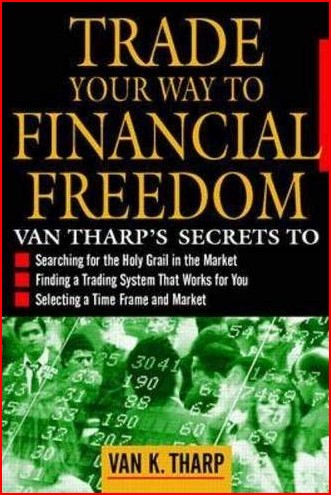
Book Summary: Van K. Tharp is a psychologist who coached traders but does not trade himself. This book written in 1999 discusses human biases, how to build trading systems, getting out of trades and position sizing.
Liked: "Trade your Way to Financial Freedom" is clearly written with lots of examples of how to design your trading system. Van Tharp does not spend too much time on identifying entry points, as he shows a random entry system can make money, but on managing the trade. Very little time is spent on entering trades because Van Tharp believes this is the least important part of the trading system. He believes that there are thousands of winning trading ideas and that provided you have shown that your idea is profitable you are destined to win big. The trick is to cut your losses quickly, deal with the risk of the trade and apply proper position sizing. Van Tharp defines position sizing as how much stock you should buy. This is quite an important area that few concern themselves with but which can have a great influence on your trading profits.
Disliked: This is a strong book but the one area where a bit more information would have been provided would be on the usefulness of indicators in system development.
Words to profit from: "One of the secrets to successful trading is finding a trading system that fits you."
Steven B. Achelis , Technical Analysis from A to Z
Book Summary: In this two part book Steven Achelis, first gives beginners the basics of technical analysis and then provides a reference source for a number of today’s top indicators.
Liked: In my version, the first part of Technical Analysis from A to Z introduces the topic of technical analysis. Topics covered are support and resistance, trendlines, moving averages, stock charts, trends and psychology. After this introduction, Steven provides a guide to indicators which covers most of the major indicators used today. As an example, for the MACD indicator, there is an overview of the indicator, an interpretation of the indicator, how to use the indicator and a stock chart illustrating the indicator. For most indicators there are 2 to 3 pages of information.
Disliked: For some of the indicators discussed in "Technical Analysis from A to Z" a secondary reference would be a good addition.
Words to profit from: "As we all know firsthand, humans are not easily quantifiable nor predictable. This fact alone will keep any mechanical trading system from working consistently."
William J. O'Neil, The Successful Investor
#3 Quick Pick
Book Summary: This book is a quick read with a lot of stock charts and commentary to help you learn how to trade using the CAN SLIM ® system.
Liked: William O'Neil, is the founder and chairman of Investor's Business Daily and the author of "How to Make Money in Stocks". In "The Successful Investor" O'Neil details how to use the CAN SLIM approach to investing. O'Neil concentrates his buying on strong stocks in strong sectors. There are a lot of stock charts presented and discussed which show both winning and loosing trades. He talks about how to buy long and sell short as well as many myths about trading. The system as presented is quite easy to follow as are the money management techniques discussed.
Disliked: The one area that this book falls short in is in investor psychology and discipline. Considering many systems break down in this area some attention should have been paid to this area.
Words to profit from: "And in the stock market, personal opinions aren't worth diddly-squat. The only opinion you need to heed is that of the market itself."
My Quick Picks
By now you may be feeling a bit overwhelmed as there are eight book summaries above and you only want one or two books. I know you do not know which one to choose but if you were to choose one, which one would it be? If I had to pick one book my favourite is Stan Weinstein's Secrets For Profiting in Bull and Bear Markets. This is just a great book to get started with.
Another one I have to recommend is the classic Reminiscences of a Stock Operator (Wiley Investment Classics) which just about every professional trader has likely read.
Finally, my newest book recommendation in this book summaries section is on trading psychology which is an area I think anyone serious in stock trading needs to understand. The best book that I have read in this area is Trading in the Zone: Master the Market with Confidence, Discipline and a Winning Attitude
What Else is in this Website
Also discussed in this website are a few book summaries on fundamental analysis.
You can also find book summaries in the magazine Technical Analysis of Stocks and Commodities. Remember, understanding the stock market takes time. You need to live through a couple of bull and bear market cycles to fully grasp what you are doing. But by following a few basic concepts you should be able to feel more comfortable with your stock trading skills.
If you are looking for other ways to generate a second income other than trading, try our alternate ideas section.
Have not found what your are looking for then check out the recent top trading books from Amazon which are featured below.
Happy reading
Investor's Business Daily, IBD and CAN SLIM are registered trademarks of Data Analysis Inc.
Gifts for Stock Traders - Stock traders are a different breed. For the stock trader in your life or as a present to yourself consider getting a trading mug. This can be used throughout the day to sip on your favourite beverage and remind you that you are a trader.


I am so proud that my first book is out. Featured in the Sept. 20, 2020 issue of Technical Analysis of Stocks & Commodities on page 62.
Dating the Stock Market
10 Key Mindsets
You Need to Excel as a Trader


Monte Carlo Simulator
for Traders
 Having troubles sticking with your trading system?
Do you move from system to system looking for the one system that will bring you riches?
Perhaps you already have it and tossed it aside when it went into a down period.
Using this Excel based program will show you what you can expect out of your trading system once you know the % wins and profit factor.
Stop wasting your time searching for the perfect system (which does not exist) and start trading.
$20.00